
What happened in the Strait of Hormuz this week
The first week of October brought one of the sharpest escalations at sea since the crisis began. According to The Maritime Executive (October 4), Iran’s IRGC Navy targeted five tankers in four days, including the Kuwaiti VLCC KAZIMAH III on October 1 and the brand-new LR2 tanker Lipsi — Greek-managed and Chinese-owned — which sustained engine-room damage. The UK’s Maritime Trade Operations (UKMTO) reported on October 4 that a tanker was struck by an “unidentified projectile”, causing a small fire and blackout that was later extinguished without casualties.
Chinese media coverage noted that in the first five days of October alone, the IRGC Navy acted against at least seven tankers it called “non-compliant”. Commercial traffic through the strait remains a fraction of pre-war levels, and the U.S. naval blockade of Iranian ports — reimposed in mid-July — is still in force.
What about diplomacy?
Signals are mixed. Iran’s president says the supreme leader backs a plan that would reopen the strait within seven days of a deal, but Washington had already rejected an earlier seven-day Iranian proposal. For freight planners the practical takeaway is clear: do not build your shipping calendar around a near-term reopening of the strait.
Iran Railways’ new corridor roadmap
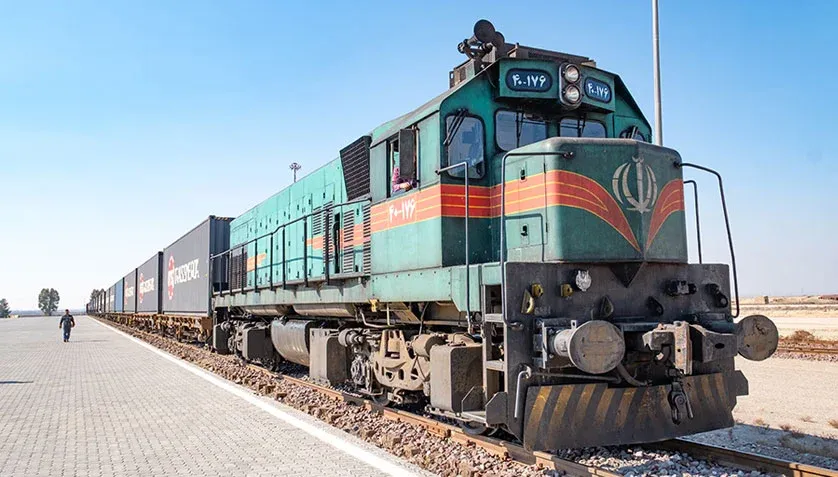
The most consequential news of the week for China–Iran trade came on land. Iranian transport outlet TINN reported on September 30 that the Islamic Republic of Iran Railways has drawn up a new corridor roadmap centred on two transit megaprojects: the Sarakhs–Chashmeh Ziarat line linking eastern borders to Turkey and Europe, and the Sarakhs–Bandar Abbas north–south axis connecting Central Asian gateways to the Gulf. Financing is planned mainly through foreign finance or oil barter, and the long-stalled electrification of the Tehran–Mashhad line is set to move forward with Chinese financing.
This is the infrastructure follow-through of the shift we covered in last month’s rail surge report: with the southern sea route unstable, Tehran is steering investment toward overland corridors.
China–Europe rail up 32% — and the southern branch is next
The regional trend points the same way. Breakbulk reports that China–Europe rail freight has surged 32% this year as the Hormuz crisis pushes shippers onto the land bridge. As the southern branch of the East–West corridor through Iran gains traction, part of that cargo flow is expected to spill over into Iranian corridors as well.
Practical takeaways for importers
- Route diversification is no longer optional. Importers who plan everything around southern seaborne containers remain the most exposed to Hormuz volatility. Combining rail, road and — where suitable — Caspian multimodal options spreads the risk.
- Set realistic transit expectations. Rail freight from China to Iran typically takes around two weeks, but border congestion can stretch this; build buffer into inventory and sales commitments.
- Lock in capacity early. As the new rail roadmap is implemented, corridor capacity should grow over the coming months — a window for negotiating stable long-term rates.
Bottom line
The early-October attacks are a reminder that a maritime de-escalation is not yet on the horizon. But the structural response — rail investment from Sarakhs to Chashmeh Ziarat and Bandar Abbas — is a historic opportunity for China–Iran trade. China to Iran rail freight is no longer an emergency workaround; it is becoming the backbone of shipping from China to Iran. To compare costs across rail, road and sea, see our freight cost guide, and contact us on WhatsApp to plan your next shipment.
News sources
- The Maritime Executive: Five tankers struck in four days; LR2 Lipsi attack (2026-10-04)
- Dawn / UKMTO: Tanker struck by unidentified projectile near Hormuz (2026-10-04)
- TINN: New roadmap for Iran’s rail corridors (2026-09-30)
- Breakbulk: China–Europe rail freight surges 32%
- Sina Finance: IRGC actions against seven tankers in five days (2026-10-04)